
Every parent has watched a child struggle to answer the simplest-seeming question in the world. Not a difficult academic question or a complex social one — but the one that arrives most naturally at the end of a hard day, or in the middle of a difficult moment: how are you feeling? The shrug that follows is not indifference. It is not avoidance. It is, very often, an accurate report: I am feeling something, and I cannot tell you what it is, because whatever is happening inside me right now does not feel like one thing. It feels like everything, all at once, tangled together so completely that I cannot find where one feeling ends and another begins.
This experience — the experience of emotions as tangled, simultaneous, overlapping, and not easily separated into clean named categories — is one of the most common and most consistently underaddressed features of children’s emotional lives. Adults tend to ask children how they feel in ways that imply a single, clear answer is available. But the child who has had a difficult day has usually had a complicated one — carrying several feelings at once, some of them contradictory, some of them unfamiliar, some of them left over from something that happened last week and has not quite resolved yet.
A well-designed emotions worksheet for kids does not ask a child to reduce what they are feeling to a single word. It gives the tangle a form — and then helps the child begin, gently and at their own pace, to find the colours in it.
The Problem With Asking How Are You Feeling
The question how are you feeling seems like an invitation. In practice, for many children, it functions more like a demand — one that requires the child to do several complex cognitive and emotional operations simultaneously: identify what they are feeling, translate it into a word, assess whether that word will be well received, and deliver it in a form the adult can work with.
That is a lot to ask of a child who is in the middle of feeling something.
Research on emotional granularity — the degree of specificity and differentiation with which a person experiences and represents their emotional states — confirms that most children, and many adults, experience their emotional lives at a relatively low level of differentiation. The child who can only access happy, sad, angry, and scared is not failing at emotional intelligence. They are working with the vocabulary and the self-awareness tools they have been given. And those tools, however limited, are the best available to them in the moment the question arrives.
Lisa Feldman Barrett’s theory of constructed emotion proposes that emotions are not pre-formed states that simply happen to us but active constructions — built by the brain from a combination of bodily sensation, prior experience, context, and the concepts we have available to make sense of what we are experiencing. What this means practically is that a child who has more emotional concepts available — more words, more frameworks, more ways of understanding the emotional landscape — will literally experience their emotions with more differentiation, more clarity, and more regulatory capacity than one who has fewer. The emotions worksheet for kids that expands the child’s emotional vocabulary is not simply teaching them new words. It is giving them the conceptual tools that build the emotional experience itself.
Why Feelings Get Tangled
The central metaphor of the Untangle Your Emotions worksheet — the messy ball of yarn, all the colours wound together until no single thread can be followed — is not simply a visual device. It is a precise and therapeutically accurate description of what emotional complexity actually feels like from the inside.
Emotions do not arrive one at a time. They arrive in clusters, in layers, in combinations that are sometimes contradictory and sometimes mutually reinforcing. A child who has been left out at school is not simply sad. They may be sad and angry and confused and ashamed and also, underneath all of that, frightened that it will happen again. A child who has just achieved something they worked hard for is not simply proud. They may be proud and relieved and surprised and also, unexpectedly, a little deflated now that the anticipation is over.
Daniel Siegel’s concept of the window of tolerance — the zone of activation within which genuine emotional processing is possible — is relevant here. A child whose emotions are tangled and undifferentiated is a child whose window of tolerance is being stretched. They cannot process what they cannot distinguish. And they cannot distinguish what they do not have words or frameworks to separate.
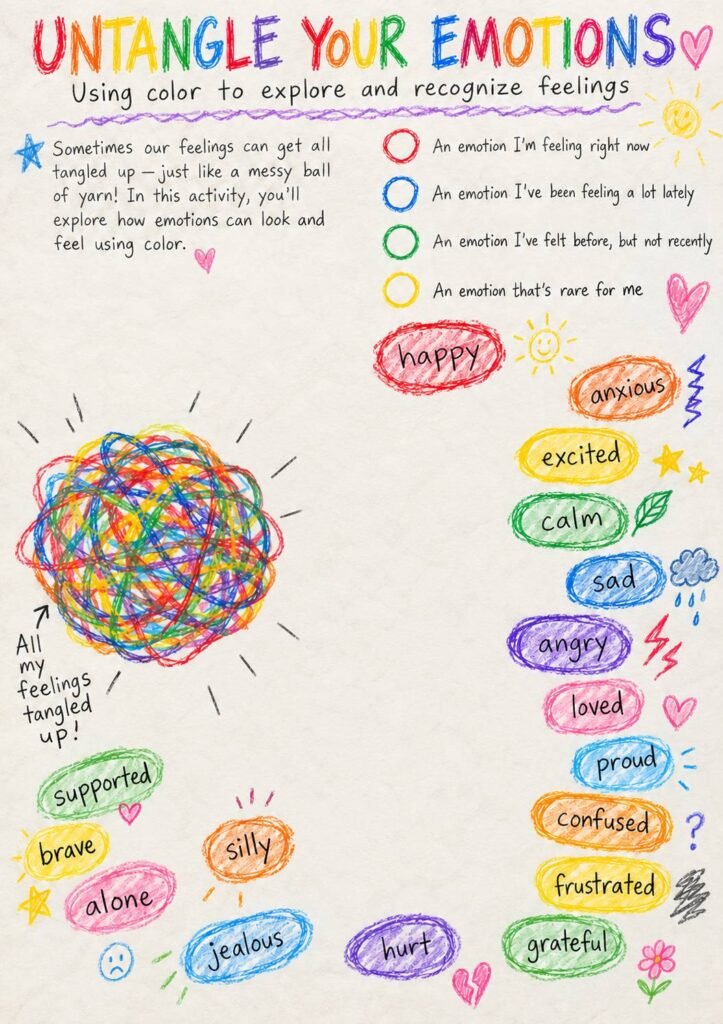
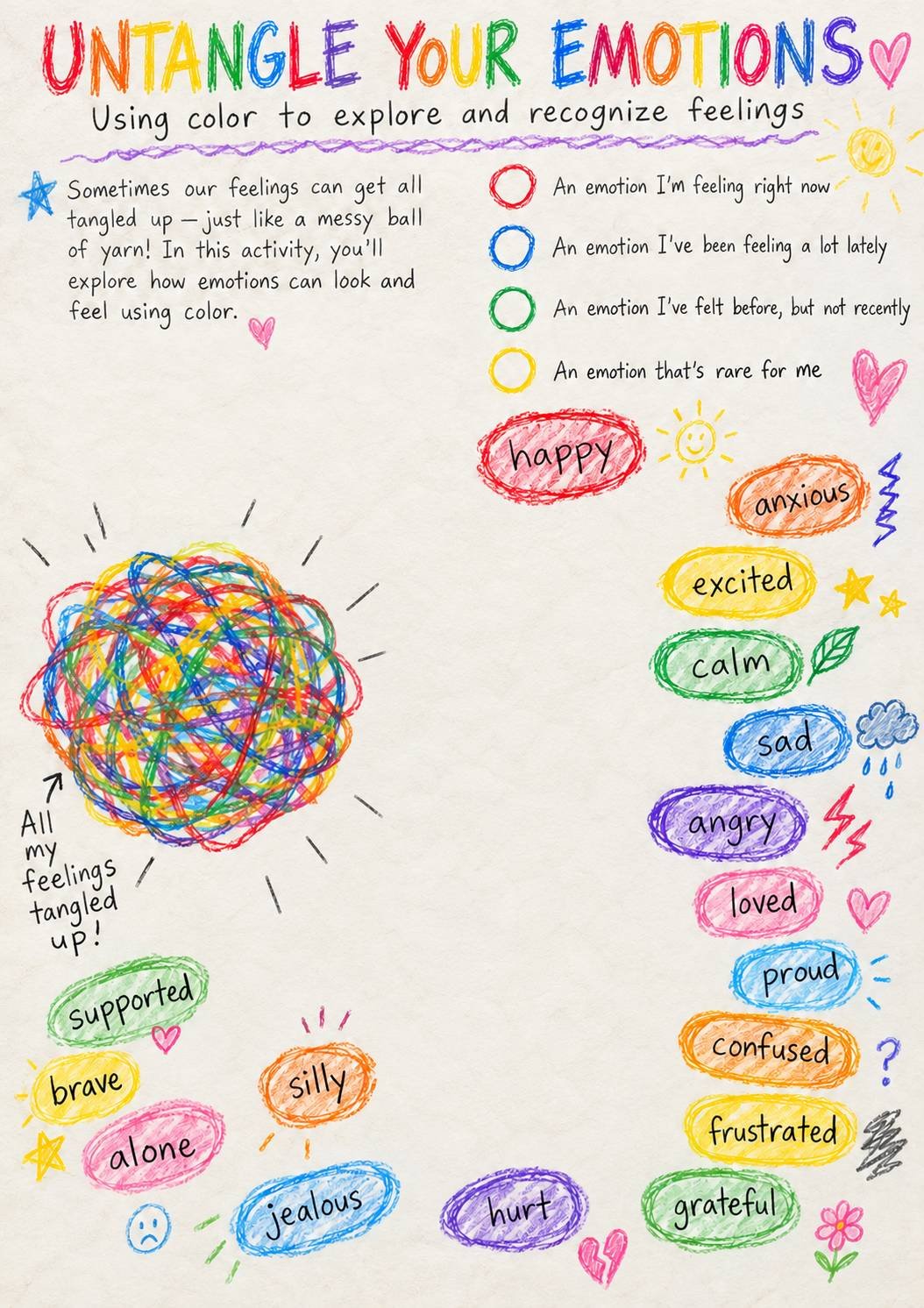
The worksheet addresses this directly. By giving the child twenty named emotions and four colour-coded temporal categories — how I feel right now, how I have been feeling a lot lately, how I have felt before but not recently, and how I rarely feel — it provides a framework for beginning to separate the threads. Not all at once. Not completely. But enough for the child to begin to see that what feels like one overwhelming thing is actually several distinct things — each with its own colour, its own timing, its own particular quality.
Free Emotions Worksheet for Kids: Untangle Your Emotions
The worksheet below — Untangle Your Emotions — is a free resource you can use with your child today. It is suitable for children aged approximately 6 to 12, and works equally well at home, in school, or in a therapeutic setting.
The child begins with the four colour-coded circles — learning the system before applying it. Red for right now. Blue for a lot lately. Green for felt before but not recently. Yellow for rare. Then they move through the twenty emotion words,, drawing a line in whichever colour applies — or leaving it blank if it does not apply at all. The coloured yarn tangle at the centre of the page is the visual anchor: all the feelings wound together, each one a different thread, the worksheet itself the process of beginning to find them.
What makes this one of the most effective emotions worksheets for kids is the combination of breadth and precision it produces. The child who has completed it has not simply named one feeling. They have mapped their emotional landscape across time, across frequency, across familiarity — and they have done it in a visual, colour-based, personally meaningful medium.
How to Use It
Introduce the worksheet during a calm, unhurried moment rather than in the middle of emotional activation. A simple, warm introduction works best: “This worksheet is about feelings — all kinds of feelings. Everyone has a tangle of feelings inside them. This is your chance to find the colours in yours.”
Walk through the colour system together before the child begins — make sure they understand what each colour means and that there are no right or wrong answers. Then step back and give the child time and space to work through it without direction or commentary. You can prompt them gently with open-ended questions, but do not tell them what they should or should not choose to draw.
Once the worksheet is complete, explore it together with open, genuine curiosity:
- Which colour did you use most — and does that surprise you?
- Is there a feeling on here that you described but have never told anyone about?
- Is there a feeling that belongs in the tangle but is not on the list?
- Looking at all the feelings — the ones you have been feeling a lot lately — do they have anything in common?
- Is there a feeling — one that is rare for you — that you would like to feel more of?
That last question is worth sitting with — because a child who can name a feeling they would like to feel more of has moved from mapping their emotional landscape to beginning to imagine how they might shape it. That movement — from passive experience to active authorship of one’s own emotional life — is the therapeutic goal that the worksheet is building toward.
For Deeper Work: The Play Therapy Toolbox
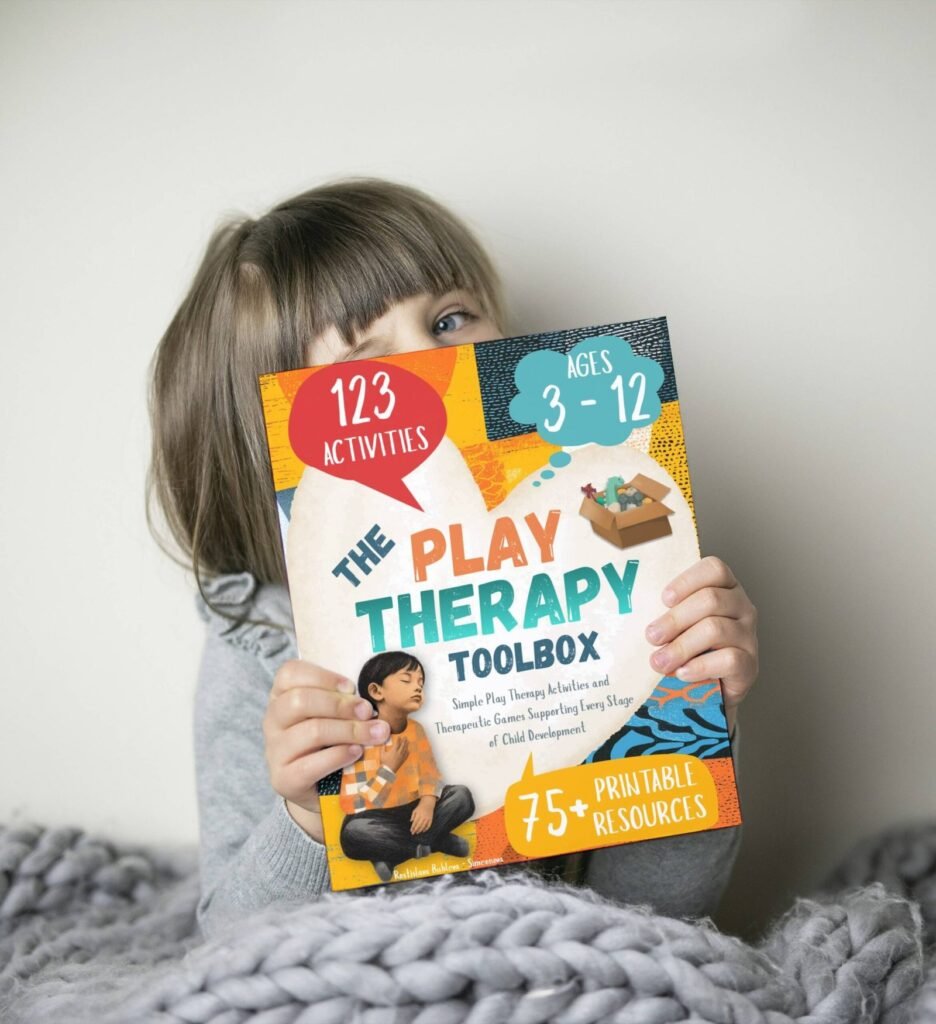
Untangle Your Emotions is one example of the kind of emotionally rich, visually grounded, developmentally precise tool that sits at the heart of The Play Therapy Toolbox: 123 Simple Play Therapy Activities and Therapeutic Games Supporting Every Stage of Child Development from Age 3 to 12 — a book built around the understanding that children develop genuine emotional intelligence not through instruction but through the direct, creative, personally meaningful experience of attending to their own inner world.
The book contains 123 activities spanning role-play, enactment, fantasy storytelling, somatic exercises, and gamified experiences, alongside 75+ printable, downloadable, full-colour worksheets designed to support and extend each activity. Every activity comes with a therapeutic rationale grounded in peer-reviewed research, step-by-step guidance on how to conduct the session and what to say, questions to use with the child, and a parent guidance note written in the same warm, accessible language as this article.
The emotional literacy and self-awareness chapters address the full range of what limited emotional awareness looks like in children: the child who has only a handful of words for the full complexity of their inner life, the one whose emotions arrive as physical sensations without names, the one who has learned to suppress the inner world entirely in the service of social acceptance, and the one who is drowning in feelings they cannot distinguish or describe. Every activity is cross-referenced in a comprehensive annex by presenting condition, age group, and page number — so you can navigate directly to the right tool for the right child at the right moment, without searching.
Before You Begin: A Note on Professional Support
Before attempting any emotional literacy activities at home with a child who is experiencing significant emotional, behavioural, or developmental difficulties, I would sincerely recommend consulting a qualified mental health professional. The exercises described in this article are offered as a supportive resource — not as a replacement for clinical assessment and ongoing therapeutic care.
Three Things Worth Knowing
Feelings are not supposed to be simple.
The most important thing any adult can communicate to a child through the use of this worksheet — and through the quality of attention brought to its completion — is this: having many feelings at once, including contradictory ones, is not a sign that something is wrong with you. It is a sign that you are paying attention. The tangled ball of yarn is not a problem to be solved. It is an honest picture of what it feels like to be a person. The worksheet does not untangle the feelings by making them simpler. It untangles them by giving each thread a colour.
Naming across time is more powerful than naming in the moment.
The four-layer temporal mapping system is the most therapeutically distinctive feature of this worksheet — and the one most worth slowing down on. A child who can identify not only what they feel right now but what they have been feeling a lot lately, what they have felt before but not recently, and what is rare for them, has developed a relationship to their own emotional life that is genuinely different from one who can only name the immediate present. That longitudinal self-awareness — the capacity to see one’s emotional experience across time rather than only in the current moment — is one of the strongest predictors of emotional regulation capacity available in the developmental literature.
You are the most important tool in the room.
A child who has experienced, consistently and specifically, the genuine curiosity and warm regard of an adult who receives whatever is in the tangle — without alarm, without the urge to fix it, without the implicit message that some feelings are more welcome than others — develops a relationship to their own emotional complexity that is genuinely different from one who has learned that simplicity is safer. Sit down. Fill in your own worksheet. Let them see what is in your tangle — and that you are not afraid to look at it.
Available Now for $5.99 — For a Limited Time
If this free emotions worksheet for kids gave you a sense of what becomes possible when children are given a framework precise enough to find the colours in their tangle, The Play Therapy Toolbox gives you 123 more tools built on the same foundation. The ebook is available now on Amazon at $5.99 for a limited time — with immediate access to 123 activities and 75+ full-colour printable worksheets for children aged 3 to 12.
Play is not preparation for life. It is life — in its most honest, most essential, most healing form.

Disclaimer: This article is intended as an educational and supportive resource for parents, caregivers, educators, and mental health professionals. It is not intended to diagnose, treat, or replace professional therapeutic or medical care. If a child is experiencing significant emotional, behavioural, or developmental difficulties, please seek guidance from a qualified mental health professional.

Rostislava Buhleva-Simeonova is a psychologist and game design specialist. She has worked with children, adults, and the elderly within various therapeutic programmes over the past eight years, all the while providing the much-needed playful twist that art and gamified experiences can bring to this sometimes uneasy setting. But it wasn’t until the birth of her daughter, Aurora, that this work took on an even deeper personal meaning. With her academic and real-life experience, honed through numerous trainings and sessions, she is currently authoring books and articles in the field of child psychology and development, offering expertise in art and play therapy to guide parents and caregivers, as well as professionals in the fields of social work and mental health, throughout various pivotal moments in children’s lives. Last but not least, all of her books have been “peer-reviewed” by her daughter, who testifies to the efficiency of these methods.